What is an LLM? Architecture, mechanics, and production limits
What a large language model (LLM) is, how it processes tokens through transformers, its real hallucination and context limits, and how to integrate it in production systems with RAG.
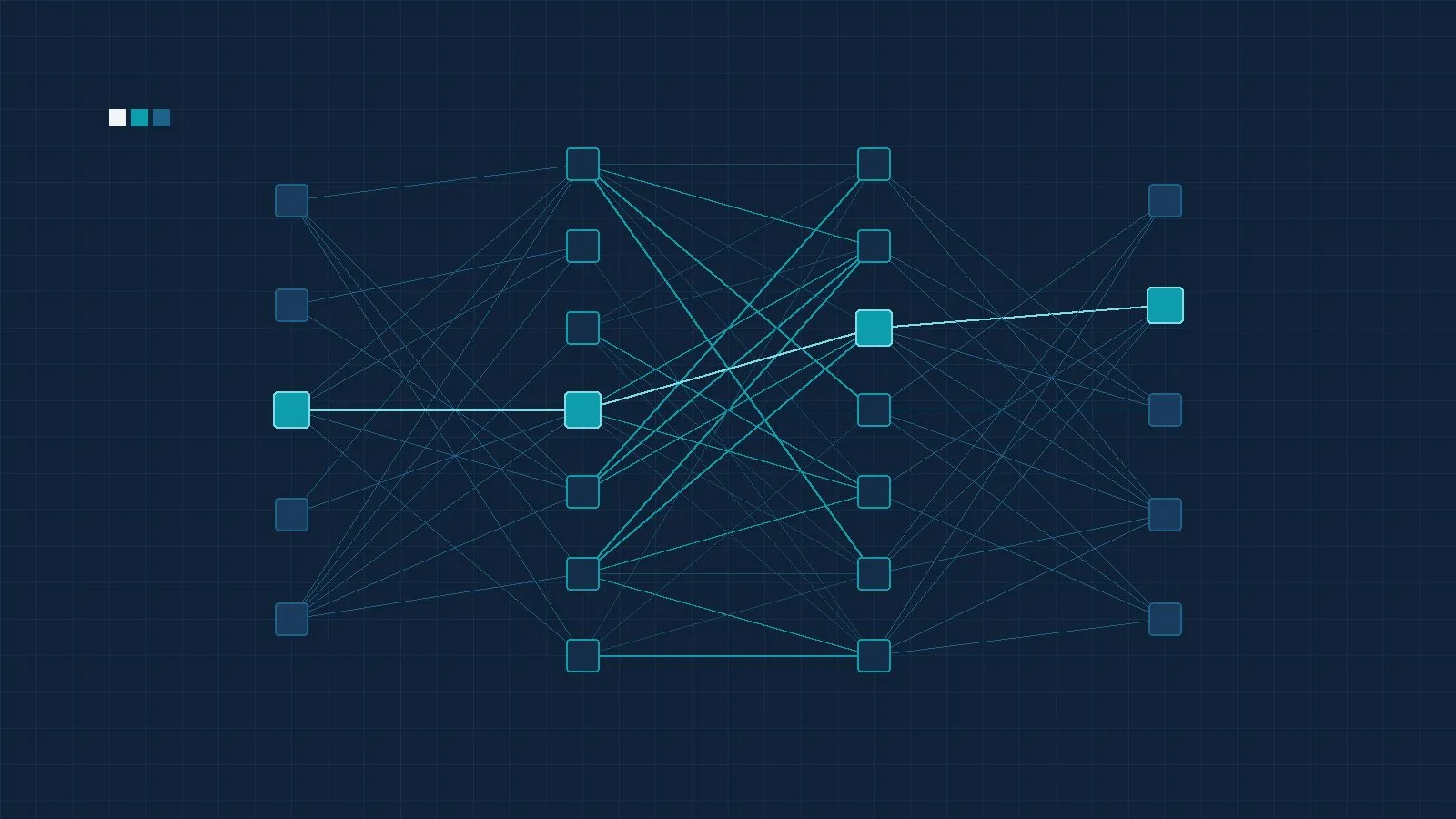
A Large Language Model (LLM) is a computational system trained on massive volumes of text to predict, comprehend, and structure both natural language and formal syntax (such as source code).
While they are commonly perceived as conversational assistants capable of drafting emails, analyzing legal contracts, or writing SQL queries from a single prompt, their underlying operation relies on statistical and mathematical principles: they do not reason with human semantic understanding or possess intrinsic knowledge. Instead, they sample sequences of symbols conditioned on learned probability distributions.
For technical leads and engineering teams, understanding what happens beneath the chat interface makes the difference between building dependable enterprise software and deploying a fragile black box that introduces silent failures into production.
How an LLM works under the hood
The foundation of modern LLMs (including GPT-4, Claude 3.5, Gemini 1.5, and Llama 3) is the Transformer architecture, introduced by the Google research team in 2017 (Attention Is All You Need). Unlike predecessor recurrent neural networks (RNNs), which ingested text sequentially word by word, the Transformer processes entire token sequences in parallel using self-attention mechanisms.
Processing a single user request follows four key stages:
1. Tokenization
LLMs do not consume raw characters or complete words directly; they split text into discrete units known as tokens using algorithms such as Byte Pair Encoding (BPE) or WordPiece.
- In English, a standard rule of thumb is that 1,000 tokens correspond to approximately 750 words.
- In Spanish and languages with rich morphological inflections, the ratio typically ranges between 1.2 and 1.5 tokens per word, as prefixes, suffixes, and accent marks are often fragmented into standalone subtokens.
- Source code (
JSON,Python,SQL) displays distinct tokenization patterns driven by indentation and special delimiter characters.
Input text: "Monthly billing"
Tokens:     ["Monthly", " bill", "ing"]  (3 tokens)
Token IDs:  [34821, 6214, 289]
2. Embeddings and self-attention layers
Each token ID is mapped to a vector in a high-dimensional space (commonly between 4,096 and 8,192 dimensions in contemporary foundation models). In this geometric space, tokens sharing semantic or syntactic properties are placed closer together mathematically.
Next, the self-attention layers calculate how every token in the sequence relates to every other token. This is achieved by computing three distinct vector projections for each position:
- Queries (Q): what a token searches for in the surrounding context.
- Keys (K): the label against which other tokens offer relevance.
- Values (V): the actual semantic payload transferred when a match occurs.
Attention(Q, K, V) = softmax((Q · Kᵀ) / √d_k) · V
This attention weighting enables the model to resolve context accurately: in the sentence “The client rejected the invoice because it was incomplete”, the pronoun “it” attends more strongly to “invoice” than to “client”.
3. Next-token prediction
Once the input sequence passes through all transformer layers, the final layer outputs a probability distribution over the model’s entire vocabulary (typically 32,000 to 128,000 candidate tokens):
P(token_t | token_1, token_2, …, token_t-1)
The model samples the next token, appends it to the sequence, and repeats the process autoregressively until it encounters a dedicated stop token (<|endoftext|>) or reaches a preset token budget. Sampling parameters such as temperature and top_p dictate whether the selection strictly chooses the highest-probability token (maximizing determinism) or allows controlled variance.
From pre-training to instruction-following
Building a production-ready LLM involves two primary phases:
| Phase | What it learns | Data and compute scale |
|---|---|---|
| Pre-training | Grammar, world knowledge, code syntax, and broad statistical patterns. | Trillions of tokens (web text, books, repositories). Requires hundreds or thousands of GPUs over multiple months. |
| Supervised Fine-Tuning (SFT) | Following direct instructions, generating structured output, and handling multi-turn dialogues. | Hundreds of thousands of high-quality prompt-response pairs crafted and curated by specialists. |
| Preference Alignment (RLHF / DPO) | Delivering concise, helpful, and safe answers while avoiding harmful, biased, or toxic outputs. | Pairwise comparisons of candidate outputs scored by human annotators or reward models. |
Pre-training yields raw linguistic and reasoning representations; fine-tuning and alignment calibrate those capabilities so the model behaves as a cooperative tool rather than an unpredictable text generator.
Technical constraints in production environments
Integrating LLMs into business workflows requires accounting for four operational realities:
1. Hallucinations (statistical confabulations)
Because models generate the most statistically probable continuation according to internal weights, they lack an internal verification engine to assess factual accuracy. When queried about topics outside their training data or presented with ambiguous prompts, they can produce syntactically flawless but completely fabricated claims (inventing legal statutes, API endpoints, or financial figures).
2. Finite context windows and attention degradation
The context window limits the total number of tokens the model can process simultaneously (combining the input prompt and earlier dialogue history). Even though modern models offer windows ranging from 128,000 up to 1 or 2 million tokens, processing massive inputs increases latency, token costs, and risks degradation on details positioned in the middle of long texts (lost in the middle).
3. Non-determinism by default
Even with temperature: 0, slight variations across parallel floating-point operations on GPU clusters can introduce minor output discrepancies. Whenever an enterprise process demands exact mathematical determinism (such as tax calculations, inventory balancing, or payroll), the logic must be executed by conventional code rather than delegated to an LLM.
4. Operational latency and cost
Every request consumes input and output tokens. While traditional microservices return responses in single-digit milliseconds at negligible incremental compute cost, calling a large model introduces hundreds of milliseconds to several seconds of latency, accompanied by variable per-token API or inference expenses.
Engineering patterns to address these limitations
In production projects at Totbits (such as automated invoice ingestion and ERP posting, or querying engineering specifications), we rely on four software patterns:
- Retrieval-Augmented Generation (RAG): instead of relying on the model’s parametric memory, we query verified company databases or vector stores for source documents and pass them explicitly within the prompt as authoritative context.
- Structured Outputs: we enforce strict JSON schemas validated via tools like Zod or Pydantic, ensuring that the downstream application receives parseable, type-safe data without unexpected text wrappers.
- Task-specialized model tiers: we deploy compact, cost-effective models for high-frequency tasks like categorization and field extraction, escalating only complex reasoning cases to high-parameter models.
- Human-in-the-loop workflows: the model executes standard transactions automatically, but triggers human review whenever confidence scores drop below a calibrated threshold before committing changes to production databases.
Primary sources and references
- Vaswani et al. (2017): Attention Is All You Need. NeurIPS 2017. arXiv:1706.03762
- Radford et al. (2019): Language Models are Unsupervised Multitask Learners (GPT-2). OpenAI Technical Paper.
- Brown et al. (2020): Language Models are Few-Shot Learners (GPT-3). NeurIPS 2020. arXiv:2005.14165
- Touvron et al. (2023): LLaMA: Open and Efficient Foundation Language Models. Meta AI. arXiv:2302.13971
- Anthropic Documentation (2024): Context Windows & Retrieval Augmented Generation Best Practices. docs.anthropic.com
- Hugging Face: NLP Course: How Transformers Work. huggingface.co/learn/nlp-course
Related articles
AI glossary in one image: token, embedding, RAG, agent, harness, and MCP
Six essential artificial intelligence concepts explained with technical clarity: how text is tokenized, vectorized, retrieved, and connected to external tools.

How much does it cost for AI to read an invoice (and how we cap it)
The real cost of automating invoices with AI isn't just tokens. How we measure per-operation cost, the levers that lower it, and why human review is part of the formula.
Django or Supabase: why our ERP and our apps use different stacks
Almeebar uses Django REST and PostgreSQL; BIT Project, BIT Talents and our CMMS use React and Supabase. The criteria we use to choose backends for each project.